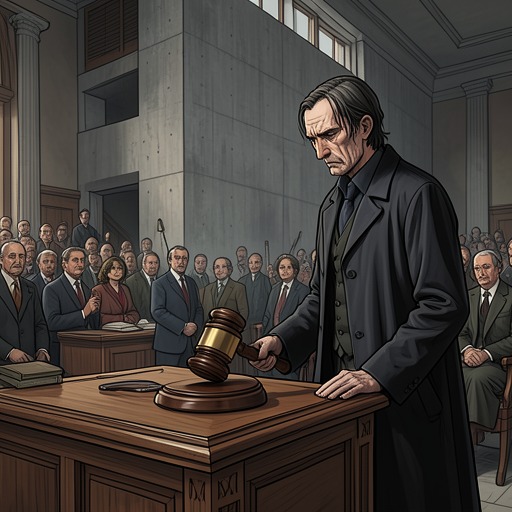
Death penalty for political terrorism and murder
Noughts & CrossesThe death-penalty rule for political terrorism and murder becomes concrete in the prosecution of Ryan Callum McGregor for the Dundale Shopping Centre bombing: he is found guilty of seven counts of murder and political terrorism, sentenced to hang, and brought to the scaffold at Hewmett Prison. A reprieve arrives only at the last moment, commuting the sentence to life imprisonment; four days later, Ryan dies during an escape attempt. Across the surrounding episodes, the punishment is framed not as an isolated legal outcome but as the endpoint of a chain joining racial hierarchy, state data collection, criminal investigation, and penal authority.
From Segregation to Criminal Suspicion
The broader setting is marked by hostility toward Nought students at Heathcroft School. A crowd gathers outside the school chanting against their admission, while Callum McGregor and three other Noughts are surrounded by police attempting to reach the entrance. The scene places public exclusion and policing in the same frame: the students’ presence at school is treated as a source of disorder, and the police line divides the Cross crowd into groups while trying to control the confrontation.
That public account is later contrasted with what the television report omits. The coverage describes the Noughts as meeting “some hostility,” but does not show the police failing to protect them from the crowd’s physical harassment or the spit covering the back of Callum’s jacket. The restrained news phrase turns an unequal and threatening encounter into a minimized incident. This contrast matters to the later criminal proceedings: the book has already shown how institutions can shape public understanding by deciding what is visible and how harm is named.
At Heathcroft, Mr Costa argues that Nought students who find school difficult should go elsewhere. Mrs Paxton counters that they are constantly picked on and warns that one of them may retaliate. Her warning links discrimination to the possibility of further conflict, while Mr Costa’s response treats exclusion as a solution rather than addressing the conditions producing hostility.
Registration, Investigation, and Prosecution
A hospital visit introduces another ordinary administrative procedure: before medical care can be given, a nurse requires the family’s identity cards under a new government rule requiring patient IDs to be checked and registered. The stated rationale is to prevent benefit fraud. Later, Ryan’s wife explains that investigators claim to have found an empty drinks can near the Dundale bombing bearing Jude McGregor’s fingerprints, which they say they cross-referenced against the print on his identity card. She believes the allegation is false and connects the police’s access to the print with the hospital’s earlier scan of Jude’s card, wondering whether the information was retrieved from the computer before the nurse deleted it.
The sequence does not establish precisely how the police obtained the data, but it makes the movement from health administration to criminal investigation a central concern. A measure presented as routine identity verification becomes relevant to a terrorism inquiry. The family’s uncertainty about whether the data was deleted underscores the imbalance between an individual’s limited knowledge of the system and the state’s ability to use information collected through it.
The police tell the family that Jude is being charged with political terrorism and seven counts of murder. The charge is later attached to Ryan at his execution: the prison announcement identifies him as convicted of seven murders and political terrorism. The legal process thus carries the story from an accusation associated with Jude’s identity evidence to Ryan’s conviction and capital sentence, though the cited scenes do not fully detail how responsibility shifts between the brothers.
At Ryan’s trial, the prosecution introduces a compilation of closed-circuit footage from Dundale Shopping Centre. The tape is described as assembled by the police, the prosecutor’s office, and two independent witnesses from prominent Nought groups, with the stated aim of ensuring that what is shown matches what was recorded on the day of the bombing. The footage unsettles Callum, while his father silently shakes his head at him. The scene emphasizes how evidence is selected and presented in court, but does not by itself establish the footage’s full contents or settle every question about the case.
Sentence, Reprieve, and Prison Death
At Hewmett Prison, Cross visitors sit while the Noughts present stand. The execution announcement states that Ryan Callum McGregor of 15 Hugo Yard, Meadowview, has been found guilty of seven counts of murder and political terrorism, that his appeal has been denied, and that the sentence of hanging is to be carried out. Only after hearing this does Sephy understand why she has been brought to the prison: Callum’s father is about to be executed. Callum is also present, and their unexpected eye contact makes the sentence personal as well as public.
The reprieve comes after Ryan has been led to the scaffold and the execution has been prepared. The governor announces that Ryan has received a reprieve and that his sentence has been commuted to life imprisonment; there will be no hanging that day. The announcement reverses the immediate outcome without clearing Ryan’s conviction or restoring his freedom. The crowd erupts, and Sephy pushes forward, while the barriers keep the visitors from reaching the scaffold.
The reprieve proves temporary in a different sense. Four days after it was granted, a news report states that Ryan has been killed while trying to escape from Hewmett Prison, electrocuted as he attempted to scale the prison’s electrified fence. The report notes that he had been due to hang before the Home Office intervened and that officials have opened an inquiry. His death is therefore not an execution under the sentence, but it follows his continued imprisonment after the sentence was commuted.
Significance of the Rule
The rule’s dramatic force lies in the contrast between its formal announcement and the unstable path surrounding it: a conviction, a denied appeal, a prepared execution, an abrupt commutation, and death in custody. The prison ceremony makes punishment visible to both Nought and Cross spectators, while the earlier scenes trace the institutional setting that precedes it—from school exclusion and minimizing news coverage to compulsory patient identification and its suspected use in an investigation.
The narrative does not offer a complete account of the law’s text, its general application, or the reasoning behind Ryan’s conviction. It does show how the threat of capital punishment concentrates the consequences of the wider conflict in one family. Ryan’s sentence shapes the prison encounter between Callum and Sephy; the reprieve changes the announced penalty but leaves Ryan imprisoned; and the subsequent report of his death closes the possibility of release through that reprieve. The law’s stated categories of terrorism and murder thus become inseparable from questions of evidence, unequal institutional power, and the human cost of punishment.